

As Australia’s poultry industry continues to monitor the spread of Highly Pathogenic Avian Influenza (HPAI), commonly known as bird flu, biosecurity has once again become one of the industry’s highest priorities.
While Australia’s commercial poultry sector has maintained exceptionally high biosecurity standards for decades, the recent detection of the H5N1 strain in wild birds has reinforced an important message: preventing disease is always more effective than responding to an outbreak.
For poultry producers, every layer of protection matters. From controlling vehicle access to disinfecting equipment and managing visitors, successful biosecurity relies on hundreds of small processes working together every day.
One area that often receives less attention than it deserves is the movement of people.
Australia’s Current H5N1 Situation
Australia has recently confirmed the presence of the H5N1 strain of avian influenza in wild seabirds for the first time. Although there is currently no evidence that the virus has entered Australia’s commercial poultry industry, authorities have significantly increased surveillance and continue to encourage producers to review and strengthen their biosecurity practices.
This is particularly important because wild birds can travel enormous distances, making early detection and prevention essential for protecting commercial poultry operations.
Government agencies continue to recommend that poultry businesses:
- Maintain strict farm biosecurity protocols.
- Limit unnecessary movement between poultry sites.
- Control visitor access.
- Ensure staff understand biosecurity procedures.
- Report unusual bird illness immediately.
- Maintain accurate records of farm access and movements.
Useful resources for producers include:
- Australian Government – Bird Flu Information
- Department of Agriculture, Fisheries and Forestry
- Wildlife Health Australia
- Queensland Department of Primary Industries
- Australian Veterinary Association
These organisations continue to publish practical guidance for producers as the situation evolves.
Biosecurity Is More Than Fences and Footbaths
When people think about poultry biosecurity, they often picture physical controls.
- Vehicle wash-down stations.
- Protective clothing.
- Footbaths.
- Controlled entry gates.
These remain essential components of every commercial poultry operation.
However, modern poultry farms have become increasingly complex.
Large producers may operate multiple farms, breeder facilities, hatcheries, feed mills and processing sites spread across large geographic regions. Staff regularly move between locations to perform maintenance, veterinary work, quality assurance, production management and administration.
Every movement introduces another opportunity for contamination if appropriate procedures are not followed.
The Hidden Biosecurity Challenge: People Movement
Consider a typical day on a large poultry operation.
- A maintenance technician visits one production site in the morning before travelling to another facility after lunch.
- A veterinarian inspects several sheds across different farms.
- An area manager visits six locations during a single day.
- A contractor completes work across multiple properties during the week.
Every one of these movements needs to comply with the organisation’s biosecurity protocols.
If someone accidentally enters a lower-risk site after visiting a higher-risk quarantine area without completing the required procedures, the risk of disease transmission increases.
This isn’t simply about recording attendance.
It’s about understanding where people have been, when they were there, and whether those movements comply with established biosecurity rules.
During a disease investigation, having access to accurate movement records can significantly improve the speed and accuracy of tracing activities.
What Good Poultry Biosecurity Looks Like
Leading poultry businesses recognise that effective biosecurity is built on multiple overlapping layers rather than a single solution.
These typically include:
- Clearly Defined Biosecurity Zones: Commercial poultry operations commonly divide facilities into different quarantine or biosecurity zones based on production type, bird age or disease risk. Access between zones should be carefully controlled and documented.
- Visitor and Contractor Management: Every visitor represents a potential biosecurity risk. Recording who enters a site, why they are there and where they have previously visited forms an important part of disease prevention.
- Vehicle Management: Vehicles can transport contaminants between locations. Many operations require wash-down procedures and maintain vehicle movement records to reduce this risk.
- Staff Training: Technology alone cannot protect a farm. Every employee should understand why biosecurity procedures exist and the role they play in protecting livestock.
- Digital Audit Trails: Manual sign-in books have served the industry for many years, but digital systems provide faster access to historical records, improve accuracy and support compliance during audits or disease investigations.
Together, these measures create a stronger and more resilient biosecurity framework.
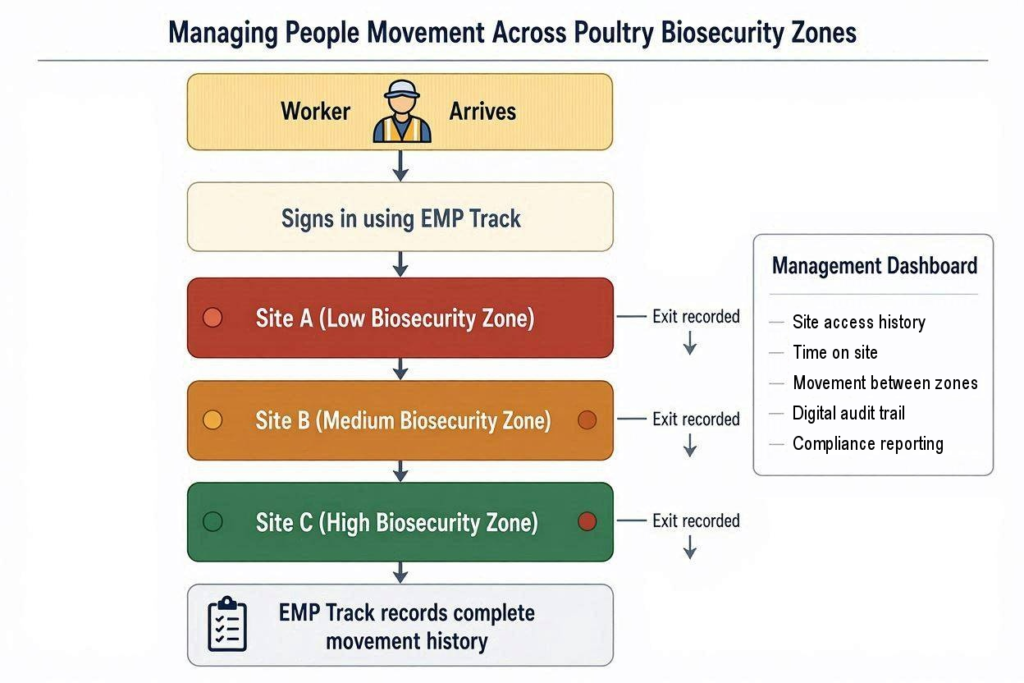
Case Study: Improving Workforce Traceability Across a Large Queensland Poultry Operation
One of Australia’s larger poultry producers in Queensland recognised that managing workforce movement across multiple production sites was becoming increasingly complex.
With employees, contractors and operational staff travelling between locations every day, maintaining accurate records of site access had become an important part of their overall biosecurity strategy.
To strengthen this process, they implemented EMP Track, a workforce tracking system designed to record employee movements across their poultry operation.
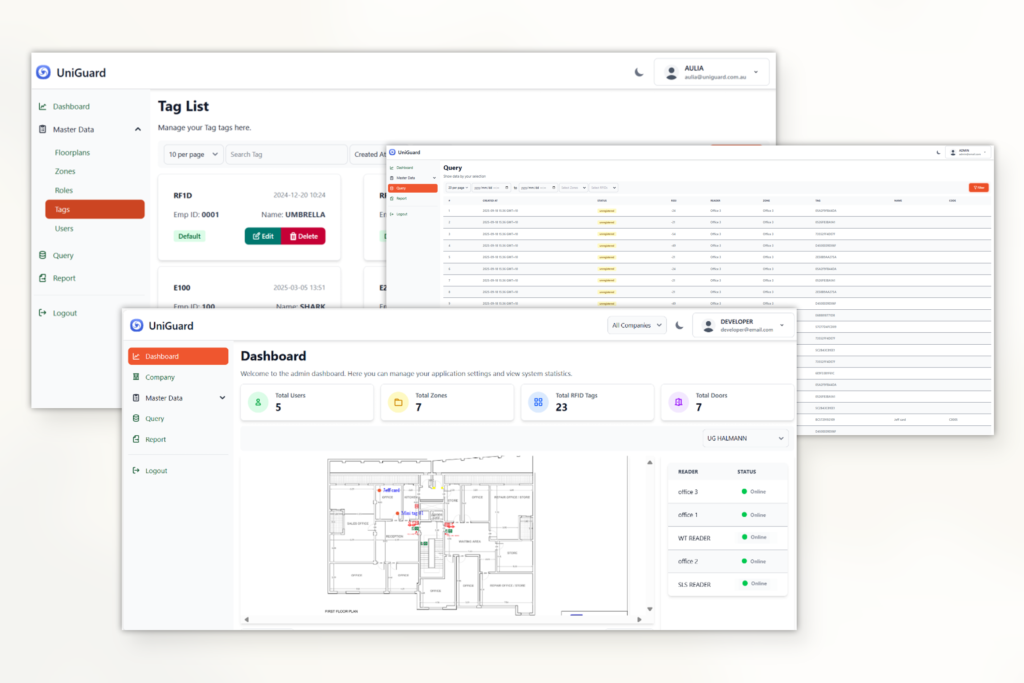
The system provides a digital record showing:
- When workers enter and leave each site.
- Which locations have been visited throughout the day.
- Historical movement records for authorised personnel.
- Movement between sites with different quarantine classifications.
This visibility helps management monitor compliance with existing biosecurity procedures and reduces the likelihood of workers inadvertently moving from higher-risk areas into lower-risk production sites without following established protocols.
Rather than replacing existing biosecurity practices, the system complements them by providing accurate, accessible information that supports operational decision-making.
The result is improved traceability, stronger compliance monitoring and greater confidence that workforce movements align with the organisation’s biosecurity requirements.
Lessons for the Wider Poultry Industry
Every poultry business is different.
Some operate a single family-owned farm.
Others manage dozens of production sites across multiple regions.
Regardless of size, several principles remain consistent.
- First, biosecurity should be viewed as an ongoing management system rather than a collection of individual procedures.
- Second, people movement deserves the same level of attention as vehicle access and equipment hygiene.
- Finally, accurate records are invaluable during audits, investigations and emergency response activities.
Whether those records are maintained using paper processes or digital systems, being able to quickly understand who has been where is becoming increasingly important for commercial poultry operations.
Looking Forward
Australia’s poultry industry has earned an international reputation for maintaining high biosecurity standards.
Protecting that reputation will require continual investment in training, procedures and practical technologies that support day-to-day operations.
As the industry responds to evolving disease threats such as H5N1, businesses are increasingly recognising that biosecurity is about more than physical infrastructure. It also depends on having clear visibility of the movement of people, vehicles and equipment across every production site.
Digital workforce tracking is one example of how technology can strengthen existing biosecurity programs without changing the underlying principles that have protected Australia’s poultry industry for decades.
For organisations operating multiple farms or production facilities, improving workforce traceability may prove to be one of the most valuable additions to an already strong biosecurity strategy.
About EMP Track
EMP Track is a workforce tracking and site access solution developed by Deltonic t/a UniGuard. It helps organisations monitor authorised personnel movements across multiple sites, maintain accurate digital audit trails and support operational compliance in environments where location history and workforce visibility are important.
While originally developed for workforce management, EMP Track has proven particularly valuable in supporting biosecurity procedures within large commercial poultry operations by providing accurate records of personnel movements between sites with different quarantine classifications.
Interested in using EMP Track for your business? Contact our team today.